
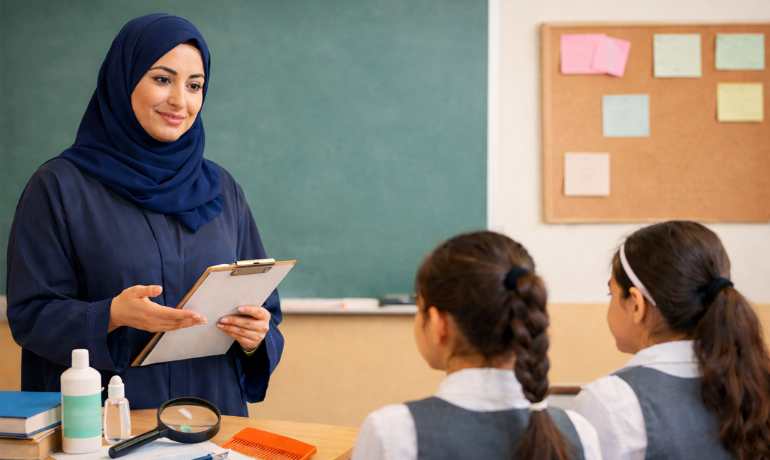
Guidelines for best school practices in dealing with pediculosis cases among students
Preparation: Spotless Hair Lice Treatment Center
Pediculosis is a common condition among school-age children, and is not categorized as a serious health condition or a contagious disease that requires exclusion or disruption of education. However, the absence of clear and publicized policies in some schools can lead to varying approaches, resulting in anxiety for parents, unnecessary absences for students, and sometimes negative psychological effects on the child.
Based on Spotless Hair’s more than ten years of experience, and based on global best practices and school experiences, this guideline has been developed to help schools and parents deal with lice in a balanced way that protects the school environment, while preserving the child’s right to education and dignity.
Disclaimer: This guide is based on best practices and is not a substitute for official regulations or directives issued by the competent authorities.
First: Basic Principles of the Guide
This guide is based on a set of basic guiding principles:
- Lice is a common health condition that is not associated with poor hygiene and does not reflect family negligence.
- Maintaining the student’s dignity is a priority and cases must be dealt with in complete confidentiality without making the student feel guilty, inadequate or embarrassed.
- Prevention and awareness are more important than punishment and isolation.
- Continuing education is a student’s right and should not be denied because of a treatable condition.
- Responsibility is shared between school, family, health and community organizations.
Secondly: Globally recognized best practices in dealing with lice
Modern health and education policies in many countries are based on the following:
- Do not exclude a student from school due to lice.
- Focus on awareness and early detection.
- Allow attendance after treatment has begun without requiring all lice and nits to be removed on the same day.
- Quiet monitoring instead of rigorous daily inspections.
- Communicate privately with the parent and provide clear guidance.
- Prevent stigmatization, bullying, and public shaming.
III: The role of school in preventing lice
1. Raising Health Awareness
- Educate students and parents about the truth about lice and how they are transmitted.
- Emphasize that lice: They don’t fly, they don’t jump, and they don’t travel through air or surfaces.
- Provide age-appropriate information to students.
2. Sending informational brochures to families to explain
- Signs of injury.
- Home testing methods.
- The right steps when the condition is detected.
- Use language that is reassuring and not alarming.
3. Promote privacy and respect for others
- Handle cases with complete confidentiality.
- Prevent any form of bullying or embarrassment.
- Training educational staff on supportive communication techniques.
4. Correcting misconceptions
- Correct rumors about lice.
- Reduce fear and unwarranted exaggeration.
IV: School Suspicion Mechanism
When lice are suspected:
- It is handled quietly and without drawing attention.
- Students are not tested in front of their peers.
- Status is not announced in class.
Fifth: Communicating with the guardian
The parent is contacted on the same day in a private manner and provided with clear instructions on:
- Home examination.
- Start treatment as soon as possible.
- Emphasize that the goal is cooperation, not blame.
VI: School Attendance (Adopted Policy)
It is not advisable to prevent a student from attending school or to impose long absences due to lice infestation because long absences negatively affect the student’s psychology and academic achievement.
Approved policy:
- The student is allowed to complete their school day.
- To continue attending after parental notification and the start of treatment.
- A medical certificate or proof of hair-free hair is not required.
- The school avoids isolation, immediate repatriation, or exclusion from classes.
Exceptional (rare) cases:
In exceptional cases where no remedial action has been initiated, it may be recommended that the student stay at home temporarily until treatment begins, emphasizing that the decision is individual and limited, without announcement or generalization.
Seventh: Community Partnership and the Role of Supporting Organizations
- Cooperate with specialized entities in health awareness and screening.
- Organize school awareness days.
- Personalized lectures for children and girls in a simple way.
- Promote the concept that prevention is a collective responsibility.
Conclusion of the manual
In conclusion, having a clear guide for schools to deal with lice is an essential step to minimize the spread of lice among students. Adopting school lice policies and establishing clear procedures when lice cases are detected in schools will help protect students and reassure parents, without affecting the educational process. This includes standardizing school lice policies, promoting lice management methods in schools through awareness, early detection, and effective collaboration with the family and competent authorities
References
- Centers for Disease Control and Prevention (CDC)
The U.S. national center that issues health guidelines, including dealing with head lice cases in schools. - The World Health Organization (WHO)
is the international public health organization that makes recommendations for the prevention of diseases and parasites. - The American Academy of Pediatrics (AAP)
is a professional medical organization that makes recommendations based on scientific research related to children’s health and the school environment. - The National Association of School Nurses (NASN)
specializes in establishing best practices for dealing with health conditions in schools, including lice.



No comment