
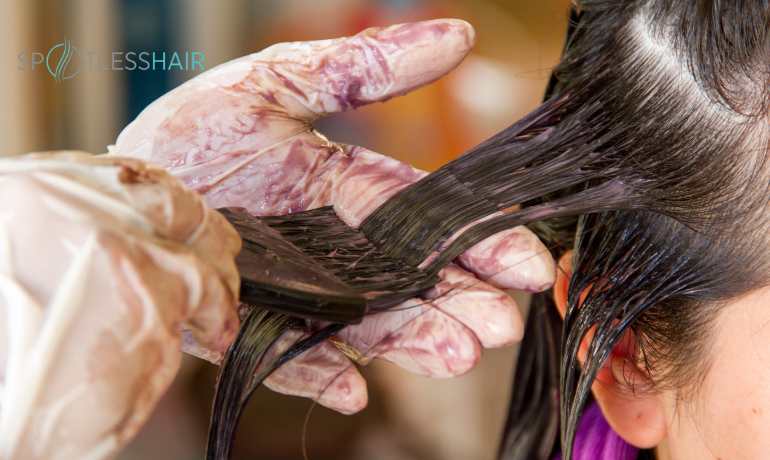
Does hair dye kill lice and lice eggs?
Many moms wonder if hair dye can get rid of lice, do the chemicals in the dye kill lice? Especially after trying many home remedies and using hair dye to get rid of lice.
In this article, we explain the scientific truth: Does hair dye kill lice and lice eggs, why you can’t get rid of lice with hair dye, and what is the best safe way to get rid of lice without chemicals.
How does hair dye work?
Some may think that hair dye kills lice because it contains chemicals such as ammonia and hydrogen peroxide. While these substances change the color of the hair and break up the natural color, they are not designed to kill lice.
Thus, even if the dye slightly affects some live lice, it doesn’t lead to a real cure. Also, the dye can’t penetrate the lice’s egg shell (the nits), so it doesn’t affect the lice eggs, which is the main cause of persistent infestation in children.
Does hair dye get rid of lice and nits?
No, hair dye does not completely eliminate lice and nits. The chemicals in the dye may temporarily kill some adult lice, but they do not affect the nits (lice eggs), which is the main cause of re-infestation after a short period of time. Therefore, the tincture may only give a temporary result, and then the lice come back after the nits hatch.
Risks of using hair dye as a lice treatment
Hair dyes typically contain strong chemicals, such as ammonia and hydrogen peroxide, which are designed to change hair color, not to treat lice. Using these substances on the scalp to get rid of lice can pose several risks.
- The dye can cause scalp irritation or mild burns.
- Hair damage and dryness as a result of the strong chemical effect.
- Also, these substances do not kill the nits (lice eggs), which leads to temporary results; the lice may disappear for a short time and then return again after the eggs hatch.
- Hair damage caused by dye can make the pigment more likely to stick to the hair, making it more difficult to remove and exacerbating rather than solving the issue.
Comparing hair dye to approved lice treatments
When comparing hair dye to approved lice treatment methods, it’s clear that dye is not a convenient or safe option for dealing with this issue.
- The effect on the nits (lice eggs), hair dye cannot eliminate them, which leads to the return of lice after a short period of time when the eggs hatch.
- The effect of the dye on lice – if any – is temporary, not guaranteed, and does not prevent re-infestation.
- Hair dye is not suitable for sensitive groups such as children , pregnant women, or those with sensitive scalps, as it contains strong chemicals that may cause irritation or damage to the hair and scalp.
- Hair dye is not a medically approved treatment for lice and is not recommended by health guidelines, unlike specialized treatments that are designed to target both lice and nits.
- In contrast, approved lice treatments rely on targeting all stages of lice, keeping safety in mind and minimizing risks, making them a safer and more effective option compared to non-personalized solutions such as hair dye.
Hair dye alternatives for lice treatment
Contrary to what some believe, hair dye is not an effective treatment for lice, and there are safer and more effective alternatives to deal with the infestation. These alternatives vary depending on the severity of the condition and the age of the person, and include several options:
- Home remedies that rely on careful combing and manual removal of lice and nits may work in minor cases but require time, patience and repeated commitment.
- Specialized lice treatment shampoos are also available, which contain active substances that target lice, but their effectiveness may vary from person to person, and may require repeated use and strict adherence to the instructions.
- In cases where the infestation is recurrent or difficult to control, professional treatment at specialized centers or salons may be an easier and faster option, as the scalp is thoroughly examined and the appropriate method is chosen for each case, reducing the chances of the nits remaining or the lice coming back.
Choosing the most appropriate alternative depends on several factors, such as the age of the injured person, the severity of the injury, the health condition, and the choice of the safest and most convenient method for each person.
Frequently Asked Questions About Hair Dye’s Relationship with Lice
1. Does the dye kill lice and nits?
Dye cannot be used to effectively eliminate lice and nits.
2. Do the chemicals in the dye kill lice?
Yes, the dye may kill some adult lice due to the strong chemicals, but it has no effect on the lice eggs. A few days after the hair dye, the eggs hatch and the lice life cycle starts all over again.
3. Do lice live in colored hair?
Yes, lice are not affected by hair color or dye type, but they do need a warm scalp to breed.
Conclusion:
Although it is commonly believed that hair dye can help get rid of lice, it is not a safe or effective treatment solution. Hair dye is not designed to treat lice, does not target nits, and may produce temporary results with risks to hair and scalp health.
Correctly dealing with lice starts with choosing specialized and safe methods that take into account the patient’s age and health condition, and target all stages of lice, which contributes to getting rid of the issue effectively and minimizing its recurrence. At Spotless Hair, we offer safe and effective, chemical-free treatment sessions to get rid of lice permanently in just one session.
- You can easily book an appointment via the Spotless Hire booking link.
- For inquiries and communication, we are happy to contact you on the unified number 920035512
- To learn more about our services, visit our website.
References:
- Saudi Ministry of Health – Head Lice
- Mayo Clinic – Head lice: Causes and treatment
- Saudi Food and Drug Authority – Warning against the use of products not intended for the treatment of lice
- Oman Ministry of Health – Head Lice


No comment