
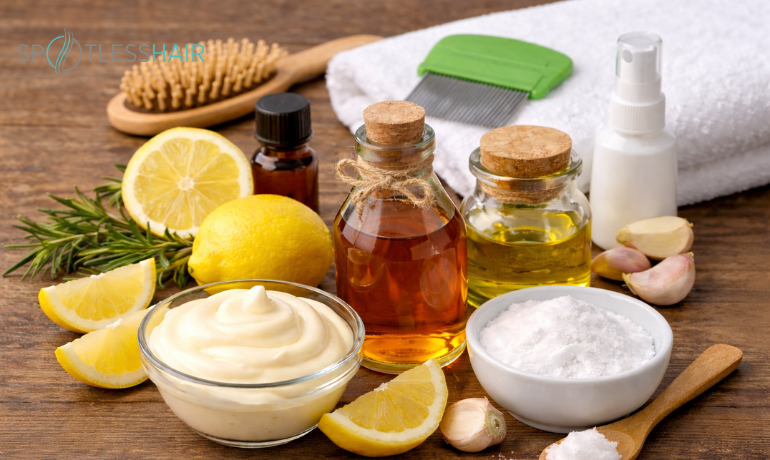
Treating lice at home with natural and safe methods
Many mothers resort to treating lice in natural ways and using recipes for lice and nits to try to get rid of and remove lice and nits at home or at work. Mothers may resort to using henna, hair dyes, or heat tools such as mastic and iron, or water such as swimming, in the hope of getting rid of lice and nits quickly. But are these methods really useful, and can they give a clear result at home without using strong substances? Before you start treating lice at home, it is important to recognize the signs of lice infestation in children, and you can read a complete guide on the signs from here.
In this article, we review the most popular methods and recipes for lice and nits at home that are popular among moms to treat lice in natural ways, and explain how effective they really are.
How to treat lice at home with natural methods
1. Lice treatment with vinegar:
Vinegar is one of the best recipes for lice and nits in helping to get rid of lice at home. Some believe that the acid in it helps break down the adhesive that binds the nits to the hair and makes combing easier, especially if used with a metal comb.
Scientific studies confirm that vinegar does not actually kill lice or nits. Concentrated vinegar cannot be used directly on the scalp, as it may cause irritation or dryness, especially in children or those with sensitive skin. Only a small amount of vinegar can be mixed with water and used with combing. The use of vinegar to treat and eliminate lice is therefore of limited effectiveness and only auxiliary in the combing process.
2. Treating lice with garlic:
One of the natural recipes for lice and nits is to treat lice with garlic. Garlic is known to be rich in natural sulfur compounds such as allicin. These substances help stimulate hair growth and improve blood circulation in the scalp. That’s why some people use it to thicken and strengthen hair. However, some people believe that garlic can kill lice because of its strong odor. However, there are no scientific studies that prove its effectiveness in eliminating lice or nits.
One of the biggest issues when using garlic to treat lice is the very strong odor. The odor can stick to the hair for days or even weeks. Even after repeated washing, due to the nature of the sulfur compounds that saturate the hair. Applying crushed garlic directly to the scalp may cause skin irritation or a burning sensation. Especially for children or those with sensitive skin.
3. Lice treatment with natural oils:
Natural oils are one of the most natural recipes for treating and removing lice and nits that moms resort to at home. Oils such as olive and coconut oil are at the forefront of these methods, because they are widely used and are considered one of the most popular home recipes among moms to get rid of lice at home, where the hair is applied with oil and left on the hair for a long time. Some believe that leaving it on the hair for 12 hours may help suffocate the lice by blocking the small respiratory openings in their body, preventing them from breathing and leading to their gradual death.
While this idea may seem logical in principle, there are no confirmed scientific studies that prove the effectiveness of olive oil or coconut oil in treating lice. However, there are no confirmed scientific studies proving that olive oil or coconut oil is 100% effective in treating lice. But it may help to some extent in making it easier to remove lice and nits when combing afterward.
4. Getting rid of lice and lice eggs with petroleum jelly and mayonnaise:
Some people turn to petroleum jelly or mayonnaise, thinking that it can help get rid of lice and lice eggs, and some consider it a treatment for lice with natural home remedies. These substances coat the hair and scalp with a thick layer that prevents the lice from moving. This prevents them from reaching the scalp and feeding on blood. In theory, this may temporarily weaken the lice because they lose the ability to move and feed. But lice can survive up to two days without feeding, so they don’t die completely until a very long time has passed.
Besides the limited effectiveness of petroleum jelly and mayonnaise in getting rid of lice and nits, their use causes the additional issue of making it difficult to use a comb for lice because their high viscosity prevents the comb from moving through the hair strands. This means that the hair must first be thoroughly washed before combing.
In addition to that, these substances are not easily washed out of the hair. These substances are very sticky and adhere strongly to the hair, making it take more than one wash to remove them, and the mother may have to repeat the wash several times to get rid of them completely. This increases the inconvenience and time spent without achieving a real therapeutic result.
5. Treat lice with mouthwash and alcohol:
Can you kill lice with mouthwash and alcohol? Home experiments have adopted the idea that mouthwash (such as Listerine) or medical alcohol can be used to get rid of lice at home because it kills lice, because it contains alcohol and strong essential oils that are believed to suffocate lice or affect their outer skin. While this idea may seem logical, studies have shown that mouthwash does not effectively kill lice or eggs, and may cause mild irritation or burning on the scalp, especially in children or those with sensitive skin. Medical reviews indicate that alcohol may kill a small percentage of adult lice, but it does not affect lice eggs (nits), so it is not a guaranteed cure.
Also, mouthwashes usually contain fragrances and alcohol in concentrations not intended for the scalp, and may cause dryness or skin irritation when used for a long time.
6. Lice treatment with lemon:
Lemon is a natural ingredient that helps cleanse the scalp and help get rid of lice at home. It contains natural acids that help break down the adhesive that holds lice eggs to the hair and leaves the scalp feeling cleaner and fresher. However, we don’t recommend using lemon to treat lice for children or those with sensitive scalps because it can cause burning or dryness. Lemon helps to cleanse, but it doesn’t completely cure lice on its own.
Personalized natural products to treat lice at home
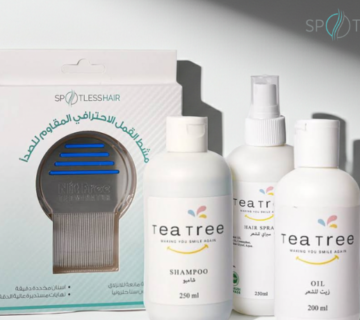
While natural home methods may help in some cases, they are not always effective, especially when lice infestations recur or the nits are difficult to get rid of. In these cases, you may need to use the T-Tree range , which is based on precise steps to remove lice.
Using the Tea Tree Lice Removal Kit
The action of Tea Tree’s chemical-free lice removal kit is based on a sequential mechanism that includes:
1. Using shampoo
- Wet your baby’s hair thoroughly, then apply an appropriate amount of shampoo and distribute it from the scalp to the ends.
- Leave it on for 3 to 5 minutes to cleanse the scalp and loosen the adhesion of lice and eggs to the hair.
- Afterward, rinse hair with lukewarm water and gently towel dry.
2. Use of oil
- After washing your hair, apply some of the treatment oil to your scalp, massaging it in gentle circular motions.
- Make sure the hair is completely covered from root to tip.
- Cover the hair with a plastic cap and leave it on for 15 to 20 minutes.
- This step helps to suffocate the lice and eggs and gently dry them without any chemicals.
3. Using the metal comb
- After removing the oil and rinsing the hair with water, use a fine metal comb.
- Divide the hair into small sections and start combing from root to tip, cleaning the comb after each pass.
- This step is essential to remove lice and dead eggs and ensure that no residue is left behind.
- It is best to repeat the combing process every other day for the first week to ensure that all lice and nits are removed.
4. Use a daily spray
After finishing the treatment, use the protective spray on dry hair before going to school or going out.
The spray forms a protective layer that helps keep hair clean.
What sets T-Tree apart from other methods?
What sets the T-Tree range apart is that it relies on organized and clear steps rather than haphazard attempts. The hair and scalp are handled in a precise manner that helps facilitate the removal of lice and nits. This method may be appropriate in cases where home methods don’t give clear results.
Is the Tea Tree Lice Treatment Kit suitable for everyone?
Yes, the T-Tree range is suitable for all ages, as it can be used for adults and children, and is a safe option for use in pregnant women when adhering to the correct method of use. The kit is used in both simple and advanced cases, with the number of combing times varying depending on the severity of the case; in simple cases, one combing session may suffice, while other cases may need to be re-combed once or twice to ensure a better result.
Frequently asked questions about treating lice with natural home remedies
1. Can lice be treated at home with only natural methods?
Natural methods may help in some minor cases, but they are not always effective, and results vary from person to person depending on the progression of the injury and the method of application.
2. Do natural recipes work to get rid of jaundice?
In some cases, natural removal can be difficult, often requires patience and careful follow-up, and may not work for everyone.
3. How often can natural home methods be tried?
It is not advisable to repeat attempts indiscriminately. If there is no improvement after a reasonable period of time, it is better to re-evaluate the condition than to continue with the same methods.
4. Can lice come back after using natural methods?
Yes, the infection may return if the condition is not fully treated or if you are exposed to a new source of infection.
5. Can the Tea Tree range be used at home?
Yes, the Tea Tree range is intended for home use and is designed so that mom can easily use it at home when adhering to the correct usage method, helping to get the best possible result.
6. Is one T-Tree Lice Treatment Kit enough for the whole family?
Yes, one Tea Tree kit is enough to treat the whole family, suitable for adults and children alike, following the appropriate application steps for each case.
Conclusion
Treating lice at home with natural methods is an option that many parents resort to, especially in minor cases or when they want to try home remedies before moving on to other options. However, the effectiveness of these methods varies from case to case, and sometimes they work and sometimes they don’t.
The most important thing is not to rely on random experimentation, and to monitor the condition carefully. If no improvement is observed or if the infestation recurs, it is best to stop multiple attempts and use specialized natural products to treat lice at home after properly assessing the situation.
- To book an appointment, please click on the booking link in the Spotless Hire Center.
- For communication and inquiries, you can contact the unified number (920035512)
- For more information, please visit our website.
Scientific references:
- Saudi Ministry of Health – Head Lice.
- American Academy of Pediatrics – Head Lice Treatment Guidelines (AAP Guidelines).
- World Health Organization – General recommendations for prevention and treatment.


No comment